
Slant Bed vs Flat Bed CNC Lathes: The Engineering Decision Matrix for Heavy Cutting vs High-Volume Production
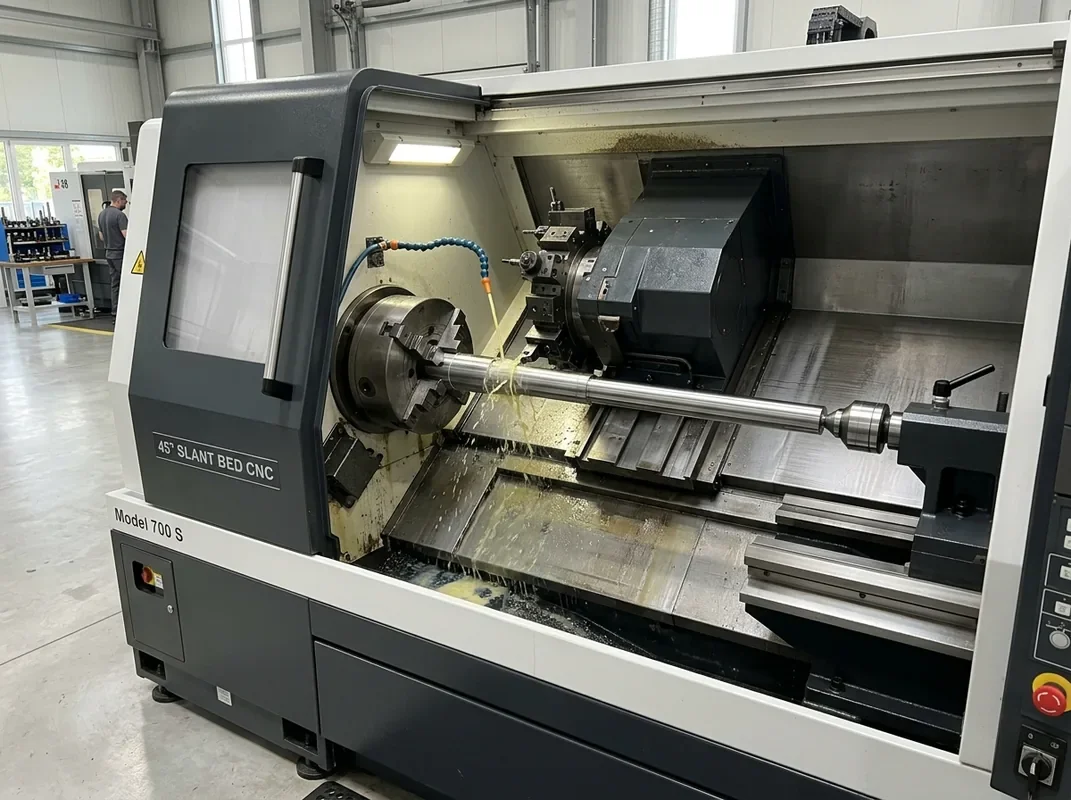
1. The Fundamental Structural Physics: 45° Slant vs Horizontal Plane
When investing in CNC turning equipment, factory managers frequently balance initial capital expenditure against long-term operational velocity. The core distinction between a slant bed CNC lathe (such as the WEIDA TCK50/TCK56) and a flat bed lathe (such as the CK6150/CK6160) originates in the orientation of the structural cast iron guide planes relative to gravity and cutting vectors.
Key Engineering Takeaways:
- Cutting Force Vector: On a 45° slant bed, the resultant vector of radial and tangential cutting forces presses the carriage directly down into the dense cast base, maximizing rigidity and eliminating vibration chatter.
- Unimpeded Gravity Chip Evacuation: Slant bed geometry allows high-velocity hot steel chips to plummet immediately into the chip conveyor without contacting guideways, protecting linear guides from thermal distortion.
- Ergonomics & Automation: Slant bed carriages afford the operator and robot arms direct line-of-sight and effortless part loading without reaching over a wide horizontal guideway.
2. Comprehensive Engineering Comparison Matrix
| Parameter | Slant Bed CNC Lathe (TCK Series) | Flat Bed CNC Lathe (CK Series) |
|---|---|---|
| Casting Angle | Monolithic 45° / 60° True Slant Bed | Horizontal 0° Flat Bed with Hardened Ways |
| Rapid Traverse Speed | 24 to 36 m/min (Linear Roller Guides) | 8 to 12 m/min (Box / Induction Quenched Ways) |
| Tool Turret Indexing | 12-Station Servo Turret (0.2s tool-to-tool) | 4 or 6-Station Electric Indexing Tool Post (2.0s) |
| Chip Evacuation | Instantaneous gravity drop to rear chain conveyor | Accumulates on horizontal bed; manual or auger purge |
| Primary Applications | Automotive flanges, bushings, batch shaft turning | Heavy repair shops, oversized flanges, pipe threading |
| Cost & ROI Threshold | Higher initial cost; lowest cycle cost in 24/7 production | Lowest capital expenditure; ideal for high-mix job shops |
3. When to Choose a Slant Bed Lathe (TCK Series)
If your manufacturing operation runs medium-to-high batch quantities, requires tight dimensional tolerances within ±0.005 mm across multi-shift production, or requires integrated turn-mill capabilities with driven tools (BMT55/BMT65), the TCK series slant bed lathe is the undisputed choice. The 45° slant bed ensures rapid heat dissipation, preventing thermal dimensional drift as the machine warms up.
4. When to Choose a Flat Bed Lathe (CK Series)
Flat bed CNC lathes excel in versatility, massive swing clearance, and low acquisition cost. For maintenance workshops, job shops handling single prototypes, and heavy industrial repairs where parts range from 50 mm to 630 mm in diameter, the CK6140, CK6150, or CK6160 offers unbeatable economic utility.
Senior Machining Applications Group
WEIDA CNC Metrology & R&D Division
Specializing in structural Meehanite machine tool dynamics, Renishaw laser pitch calibration, and turnkey production engineering at Shandong Weida CNC Machine Tool Co., Ltd.
Procurement & Engineering Inquiry
Submit your machining requirements. Our engineering team provides detailed quotations and toolpath feasibility within 2 hours.